Law firms are operating in a market where clients place a growing premium on value, efficiency, productivity and technology-enabled service delivery. In the UK, Thomson Reuters reports that corporate legal departments are increasingly focused on efficiency and value, while law firms are under pressure to adapt their service models and demonstrate clearer commercial benefit. At the same time, legal marketing leaders are taking on more strategic responsibility. The 2025 Legal Marketing Decision-Makers Survey found that strong majorities of respondents are involved in firmwide strategic planning, and 70% report taking on greater roles in legal tech.
Against that backdrop, the law firm website can no longer be treated as a brochure. It is a strategic business development platform. It shapes first impressions, distributes thought leadership, routes high-intent interest, and enables or constrains marketing execution. When that system creates friction, the cost is rarely obvious in one dramatic failure. More often, it appears as quiet underperformance: fewer enquiries than the firm should be generating, slower campaign launches, weaker cross-sell journeys and hours of internal delay.
This paper outlines 10 common forms of website friction that create commercial drag in law firms. Some reduce conversion directly. Some delay the progression of high-intent opportunities through the client acquisition pipeline. Some waste internal time that should be spent on growth. Together, they can materially reduce the return a firm gets from its marketing, content and brand investment.
Why this matters now
The legal market is shifting in ways that make website performance more commercially important, not less. Thomson Reuters’ State of the UK Legal Market 2025 finds that clients are reassessing how they buy legal services, with increasing attention on value, pricing transparency, efficiency and technology. Its COO & CFO Forum summary also shows law firm operational leaders balancing present pressures with future investments in efficiency, client service, data governance and technology. In other words, firms are being pushed to do more with clearer commercial discipline.
At the same time, a poor digital experience creates avoidable risk. Clio’s current UK law firm website guidance, citing its Legal Trends research, says only 30% of law firm websites clearly explain the process of hiring a lawyer and only 14% provide pricing information. It also notes that 73% of prospective clients are unlikely to recommend the firms they contact. While that research is more consumer-oriented than large corporate firm buying journeys, it still points to a broader truth: legal websites often create uncertainty at the exact moment clarity matters.
Reframing the website
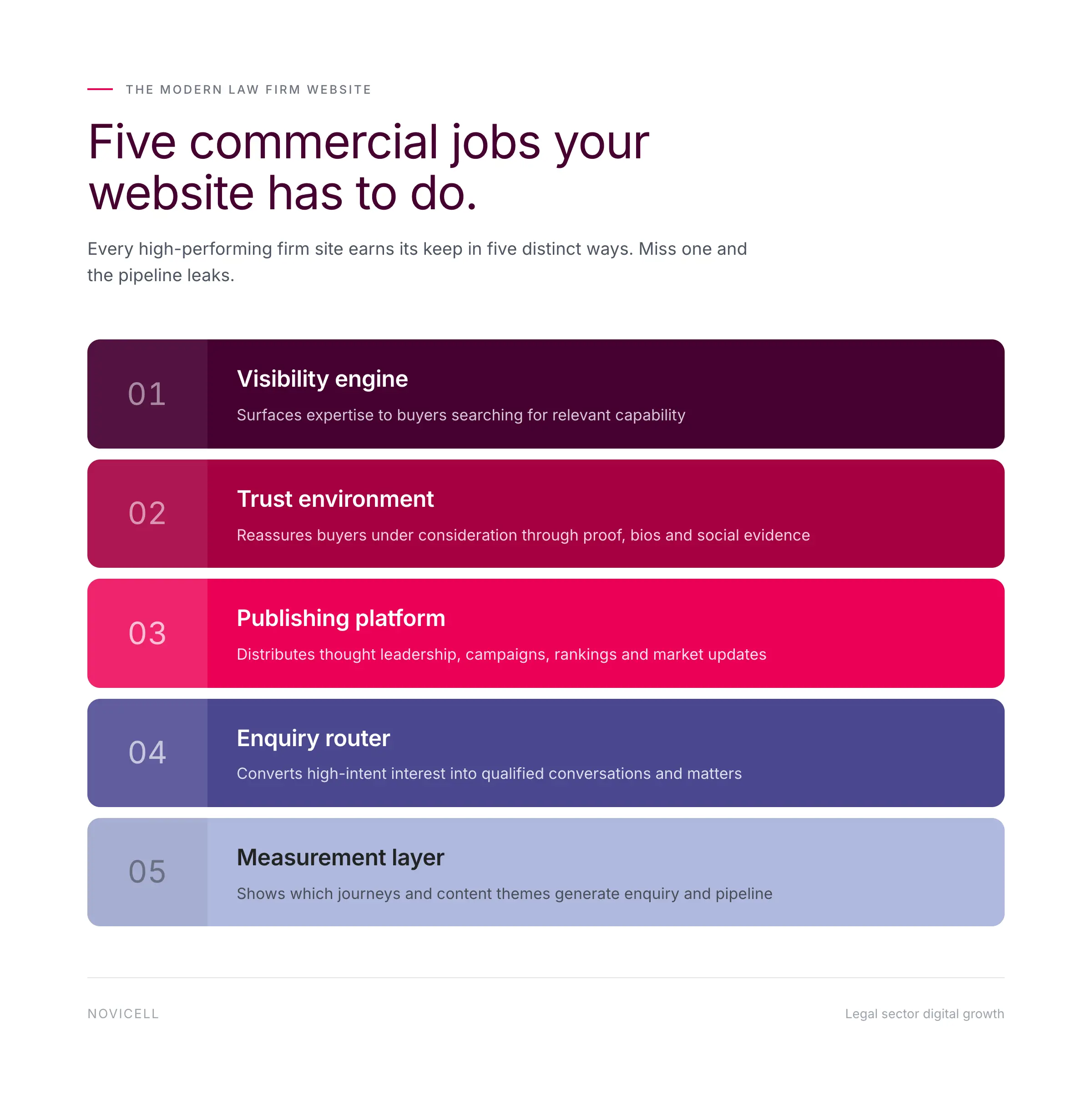
A modern law firm website does at least five jobs at once. It is a visibility engine for expertise, a trust environment for buyers under consideration, a publishing platform for marketing and BD, a routing mechanism for enquiries, and a measurement layer for digital performance. When any of those break down, the problem is not merely aesthetic. It is commercial.
This matters especially because legal marketers are already being asked to operate more strategically. The LMA survey shows that more than half of marketing leaders surveyed are directly involved in their firm’s strategic planning process, and almost 20% say they are the primary authors of those plans. A website that slows their ability to execute, test, publish and prove value becomes a constraint on firm strategy itself.
How website friction creates financial loss
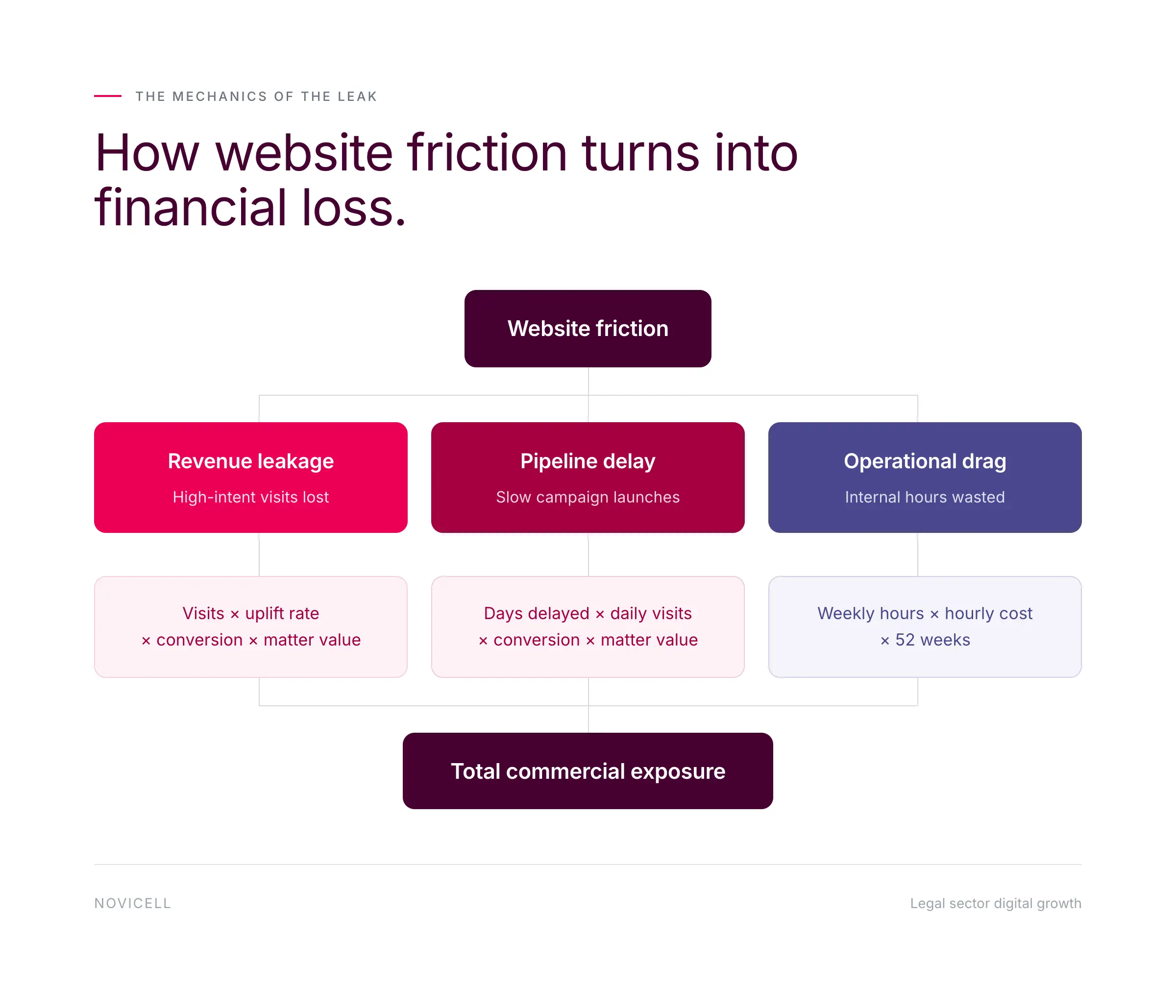
Website friction usually creates commercial loss in three ways.
First, it causes revenue leakage. High-intent visitors do not become enquiries, conversations or matters when practice pages are unclear, bios go nowhere, mobile journeys underperform, or contact routes are awkward.
Second, it creates pipeline delay. Campaigns, rankings, lateral hire announcements, sector pages, event content and practice launches go live too slowly because the website is too rigid or too dependent on technical intervention. In a market where clients are moving towards value and speed, delayed execution is not just inconvenient. It can reduce the window in which demand is captured.
Third, it creates operational drag. Marketing and BD teams lose hours each week to formatting, workarounds, approvals, duplicate processes and developer dependency. That cost may not show up as lost revenue on a single line, but it still lowers the return on salary, agency spend and campaign investment.
A practical commercial model
For the purposes of estimating website-related commercial exposure, this uses three simple models.
For direct conversion loss:
Revenue at risk = high-intent visits × recoverable conversion uplift × lead-to-matter rate × average opening matter value
High-intent visits: the number of website visits from users actively looking for legal expertise, services or contact with the firm.
Recoverable conversion uplift: the estimated percentage increase in conversions achievable by removing website friction or improving user experience.
Lead-to-matter rate: the percentage of enquiries or leads that ultimately become billable client matters.
Average opening matter value: the average commercial value of a newly opened client matter at inception.
For delayed launches and campaign publishing:
Pipeline delayed = days delayed × expected daily high-intent visits × expected conversion rate × lead-to-matter rate × average opening matter value
Days delayed: the number of days a website launch, campaign or content release is postponed.
Expected daily high-intent visits: the projected number of commercially valuable visitors expected per day during that period.
Expected conversion rate: the percentage of those visitors expected to generate an enquiry or meaningful engagement.
Lead-to-matter rate: the percentage of leads expected to convert into active legal matters.
Average opening matter value: the average initial value of those matters to the firm.
Weekly hours lost: the estimated number of staff hours spent each week on avoidable operational inefficiencies, manual workarounds or platform friction.
Blended hourly cost: the average hourly employment cost across the relevant marketing, BD, digital or fee-earning teams.
52: the number of working weeks used to annualise the operational impact.
These are not claims of exact lost revenue based on public observation alone. They are directional models designed to help firms estimate commercial exposure and prioritise improvement. That distinction matters.
The 10 revenue leaks
#1-Practice pages that fail to convert high-intent visitors
Practice pages are among the most commercially important assets on a law firm website. They sit close to need, intent and self-qualification. When they are generic, overloaded, weak on differentiation or unclear on next steps, they suppress enquiry from users who may already be close to instructing.
#2-Lawyer bios that act as dead ends
Bio pages are not just profile pages. They are trust pages. Buyers often use them to judge relevance, seniority, sector knowledge and credibility. If those pages do not offer a clear onward path into related practice content, sector expertise or a contact route, the user journey often ends at the point where confidence should be peaking.
#3-Contact journeys that create abandonment
Many legal websites still make interested prospects work too hard to get in touch. Generic "contact us" pages, lengthy forms, poor mobile completion and unclear routing all reduce the percentage of serious visitors who become real conversations. This is one of the clearest points at which friction turns into lost opportunity.
#4-Mobile journeys that underperform at critical moments
Even in corporate legal buying, mobile often plays an early discovery or research role. A weak mobile experience on key pages can reduce engagement before trust is built, especially when navigation is awkward, calls to action are buried, or content hierarchy collapses on smaller screens. Clio’s guidance is explicit that mobile friendliness is now a basic expectation for legal websites.
#5-Slow page performance on commercially important pages
Slow pages create friction before a visitor has even absorbed the message. On pages tied to practice, lawyer expertise, thought leadership or campaign activity, poor speed can undermine both perception and completion. Even where the content is strong, sluggish delivery reduces the chance that users continue the journey.
#6-Navigation and search that hide expertise
Law firms often have complex information architectures: multiple practices, sectors, geographies, offices, publications and lawyer profiles. When navigation or search does not help users find the right route quickly, expertise becomes harder to discover and commercial intent gets lost in the structure.
#7-Weak proof at the point of consideration
Legal buyers do not only want information. They want reassurance. If a firm’s key pages do not provide enough evidence of relevance, credibility, sector understanding or practical outcomes, users may leave informed but unconvinced. In that sense, weak proof does not just hurt brand perception. It hurts conversion.
#8-Slow publishing workflows that delay market response
A website that takes too long to update turns marketing into a queue. That means slower reaction to rankings, legal updates, campaign activity, lateral hires, events and market moments. The LMA survey’s finding that marketing leaders are increasingly central to strategy makes this more significant. If execution is slow, strategy loses force.
#9-Inflexible page structures that limit growth activity
When every new page or campaign requires bespoke development work, firms lose the ability to move quickly. In practice, this means fewer landing pages, slower campaign roll-outs, less experimentation and greater dependence on developers for routine activity. For growth-oriented firms, rigidity is expensive.
#10-Poor measurement of what actually drives enquiry
Firms cannot optimise what they cannot see. If analytics do not show which pages, journeys and content themes generate meaningful enquiries, the marketing team is left arguing from activity rather than evidence. In a market where value and productivity are rising as client priorities, that blind spot carries real strategic cost.
To make the commercial model more concrete, consider an illustrative example based on a mid-sized to large UK commercial firm. This is not presented as audited data from a named firm. It is a conservative model built from publicly visible traffic ranges and legal industry conditions. Public traffic estimators suggest that large law firm sites can attract anything from tens of thousands to hundreds of thousands of monthly visits. For example, Similarweb currently estimates roughly 72,100 monthly visits for dacbeachcroft.com and roughly 304,500 for hoganlovells.com. Against that backdrop, assuming 40,000 monthly sessions for a substantial UK commercial firm is a cautious starting point.
Assume that a firm has:
40,000 monthly website sessions
5,000 monthly visits to high-intent practice, sector and lawyer pages
A current high-intent conversion rate of 0.6% into qualified enquiries
A realistic, improved conversion rate of 0.9% after reducing friction
A lead-to-matter rate of 20%
An average opening matter value of £15,000
These assumptions are deliberately conservative for a commercial law context, especially given the size and value range of many B2B legal matters. They are intended to illustrate the mechanism, not overstate the case.
Under that model, the monthly recoverable revenue at risk from high-intent under-conversion alone is:
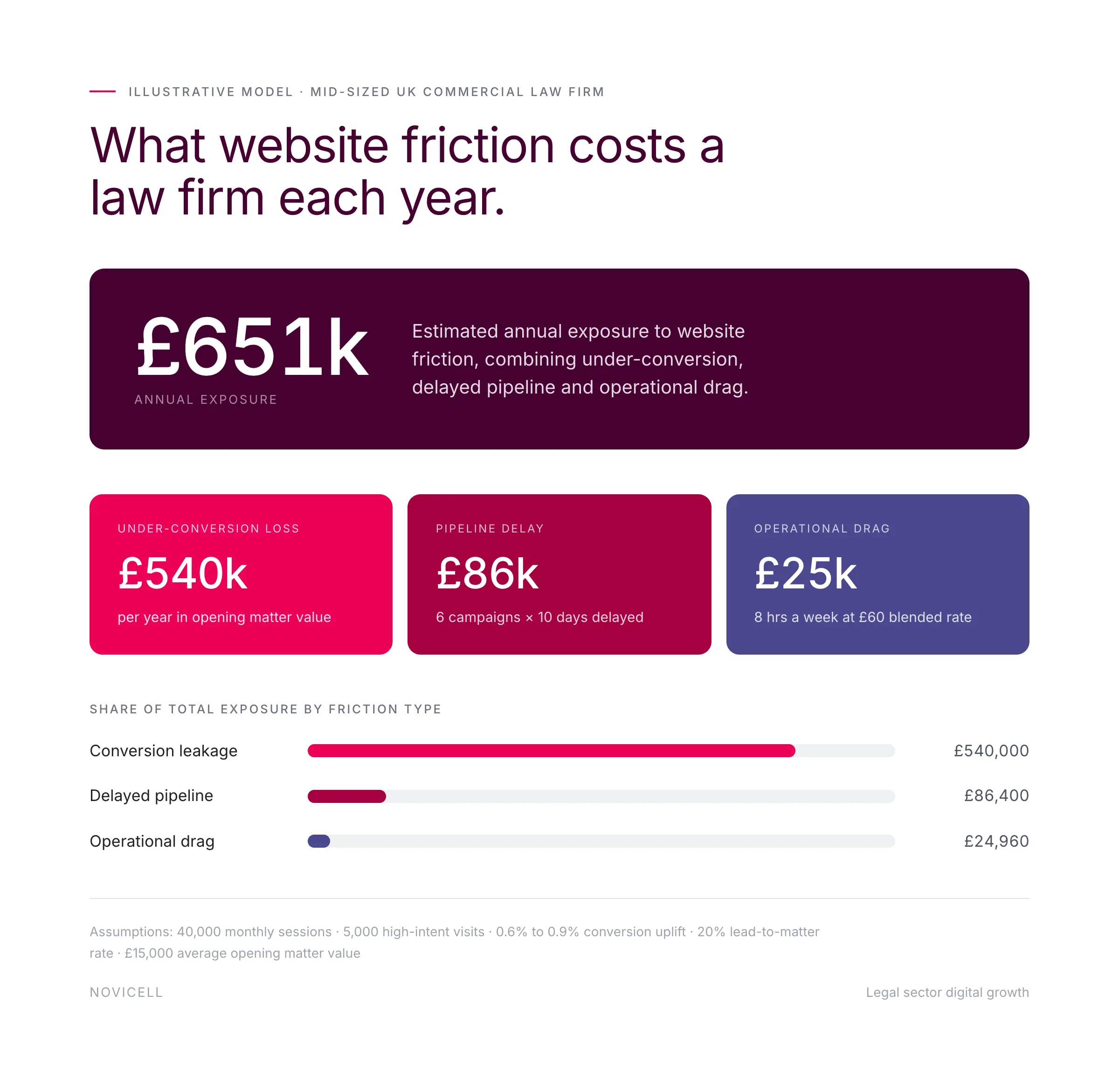
That equates to £540,000 per year in opening matter value at risk, before considering any additional upside from better cross-sell, improved lead routing or higher-value matters. This is exactly why website friction should be treated as a commercial problem rather than a design tidy-up.
Now add a publishing bottleneck. Suppose the same firm runs six meaningful campaigns or market-response launches per year, and website friction delays each one by 10 days. If each launch could reasonably attract 60 high-intent visits per day at a 0.8% conversion rate, with the same 20% lead-to-matter rate and £15,000 opening matter value, the delayed pipeline looks like this:
6 × 10 × 60 × 0.008 × 0.20 × £15,000 = £86,400 per year
Again, that is not lost forever in every case, but it is pipeline delayed or missed because the website could not support timely execution.
Finally, assume the marketing and BD team loses a combined eight hours per week to CMS workarounds, reformatting, developer dependency and inefficient publishing processes. At a blended cost of £60 per hour, that operational drag costs:
8 × £60 × 52 = £24,960 per year
Taken together, this illustrative firm could easily have more than £650,000 per year of opening matter value and internal cost exposed to website friction, even before harder-to-measure effects such as weaker perception, lower cross-sell or poorer measurement. The exact number will vary by firm, but the pattern is commercially plausible.
What better-performing firms do differently
Firms that reduce this drag tend to do a few things consistently. They design practice and lawyer pages around real user questions, not internal structure. They make contact and next steps obvious. They give marketing teams modular publishing capability so they can launch quickly without heavy technical dependence. They treat analytics as a decision-making layer, not a reporting afterthought. And they design for change, so the site can evolve as the firm’s strategy, sectors, and campaigns evolve.
That last point matters because the legal market is not standing still. Firms are being pushed to become more efficient, more technology-enabled and more client-aligned. A rigid website is not neutral in that environment. It is a drag on adaptation.
In conclusion
Most law firm websites do not fail loudly. They leak value quietly. They do it when high-intent visitors cannot find the right route, when proof is weak, when contact paths are clumsy, when pages load slowly, when marketing teams cannot publish quickly, and when firms cannot see which journeys actually influence enquiry and pipeline.
For firms under pressure to show value, speed up execution and protect future flexibility, that should not be treated as a minor digital issue. It is an operational and commercial one. The firms that get more from digital will not necessarily be the firms with the most traffic. They will be the firms that remove friction from the moments closest to action.
Revenue Calculator
Estimate how much revenue your law firm website could be quietly losing
Enter your traffic and enquiry numbers to see how your conversion rate stacks up against other firms, and what it's costing you.
Takes 2 minutes. No signup required.