Ask most law firms what their website costs, and you'll get an answer fast. Ask what it earns, and you'll get a pause.
That pause is the problem. Somewhere along the way, the website got filed next to the office lease and the photocopier contract: a thing you renew, patch, and mostly ignore until it breaks. Reviewed every five years if you're lucky. Judged on whether it's up, not on what it's doing while it's up.
For a firm competing on trust and visibility, that's not a minor filing error. It's money left on the table, quietly, every day nobody's looking.
Stop asking what it costs
A law firm site doesn't take payment, so it's easy to wave away the revenue argument. No cart, no checkout, no neat number to point at. But think about what actually happens on that site. A general counsel does their due diligence there before an instruction ever lands. A lateral hire candidate forms half their opinion of the firm there before the first call. And now, more often than anyone in the marketing team probably realises, an AI tool is quietly deciding whether your firm gets mentioned at all when someone asks it who handles a particular matter in a particular place.
All three of those are revenue events. None of them will show up on a maintenance report.
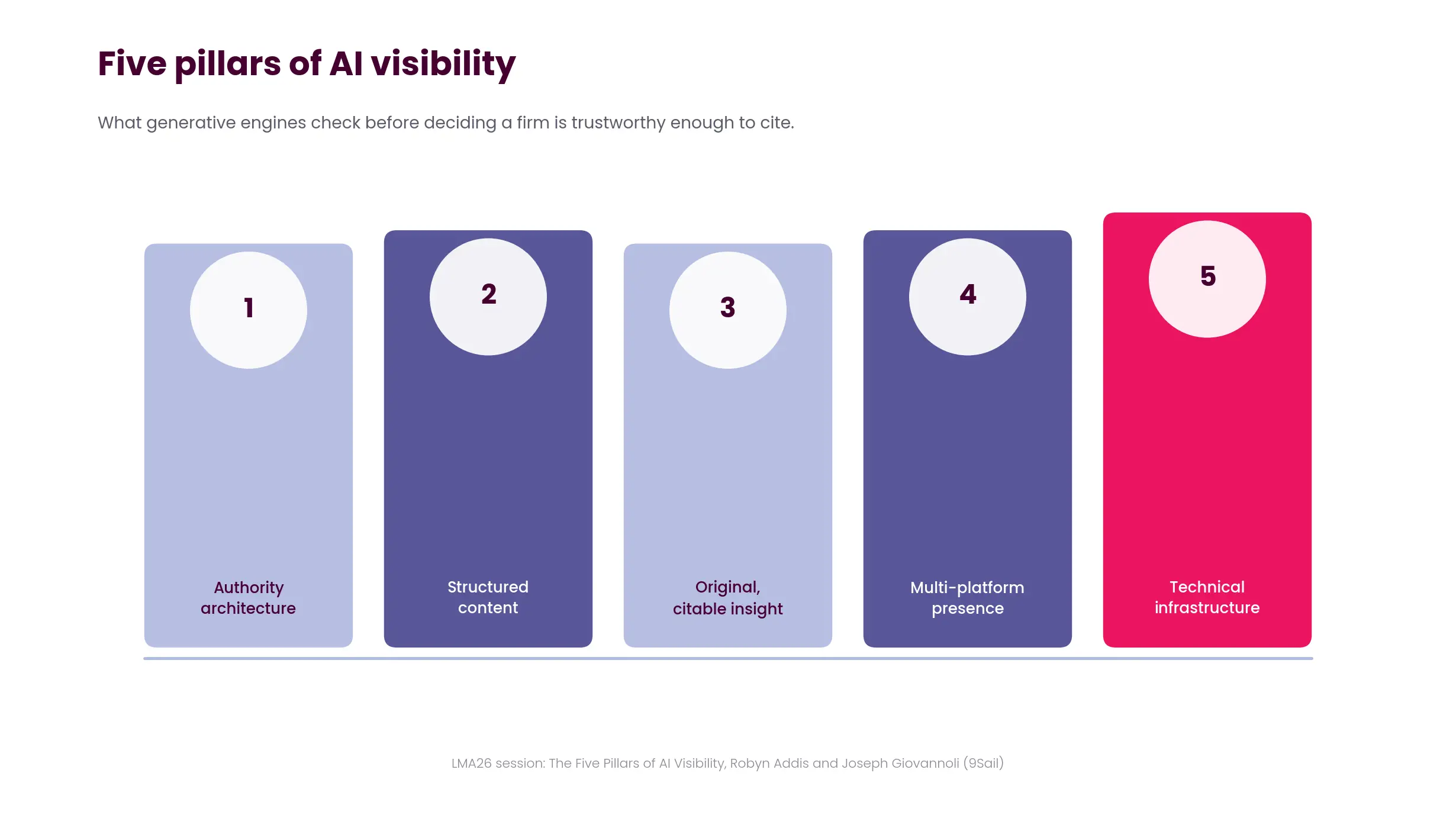
That last one is moving fast. The Five Pillars of AI Visibility framework presented at LMA26 names technical infrastructure (speed, crawlability, clean architecture) as one of the five things AI systems check before deciding a firm is trustworthy enough to cite. Get it wrong and you do not rank lower. You disappear. Not from the 10th page of Google, but from the conversation entirely, because the tool never mentioned you in the first place.
The mess nobody wants to own
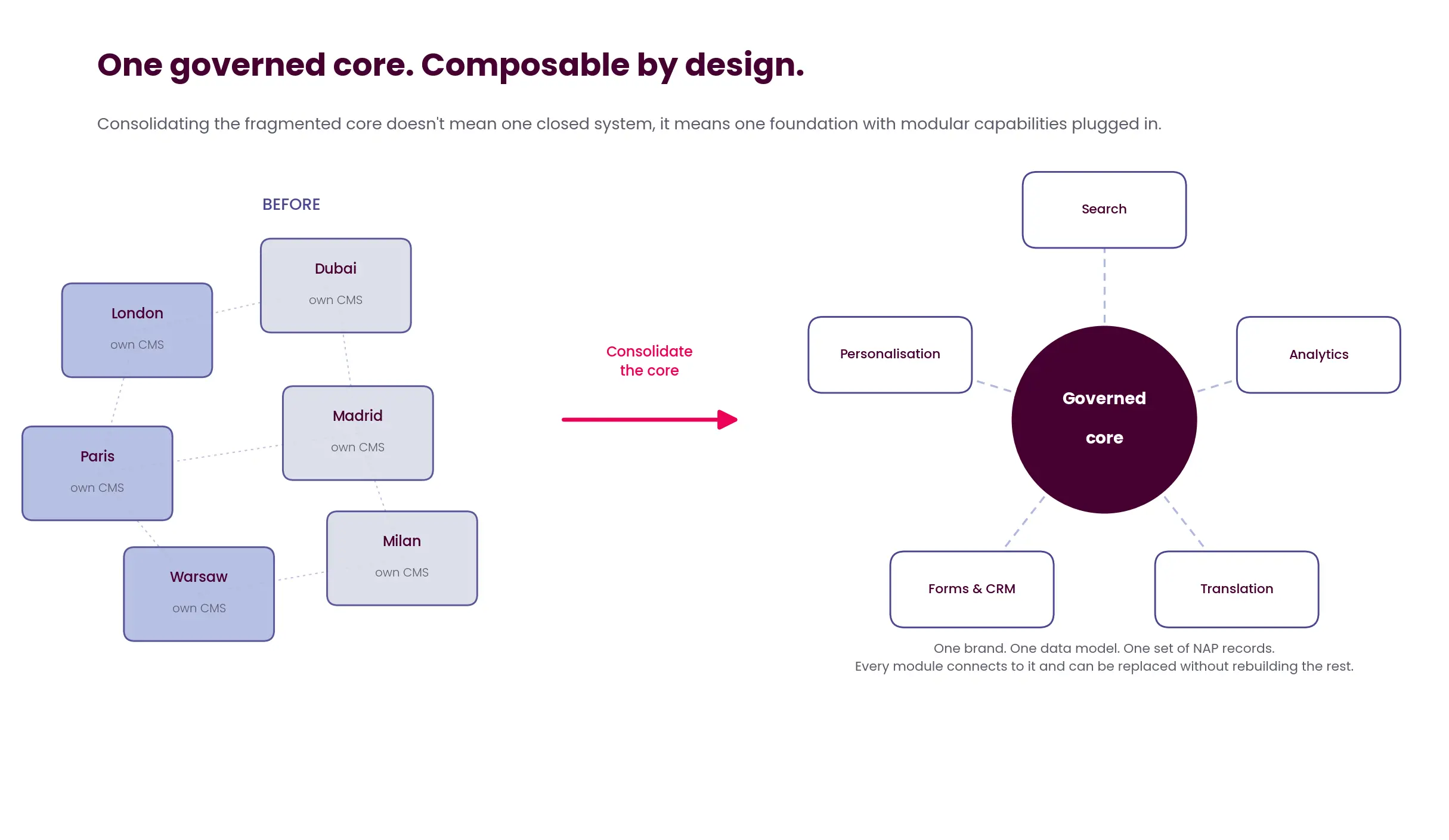
Walk into most multi-jurisdiction firms and ask how many content management systems they're running, and watch the frustration pile in. Each one a hangover from a merger, or a compromise struck years ago to keep a regional office happy. Each one with its own licence, its own dev backlog, its own slightly different version of the brand.
It's not just wasteful, though it is that. It's actively working against you. When your London office lists one phone number and your Dubai office lists a different format entirely, that's not a rounding error. It's the exact kind of inconsistency that tells AI systems, and search engines before them, that they can't quite trust what you're telling them about yourself. The fix isn't one closed system trying to do everything. It's one governed core, holding the brand, the data and the NAP records straight, with search, personalisation and the rest composed around it and free to be replaced without rebuilding the whole site. That's the difference between tidying up and actually being found, correctly, wherever your buyer happens to be asking.
A tenth of a second, apparently, is worth millions
Here's a stat that has nothing to do with law firms and everything to do with why this matters. Google and Deloitte ran a study called Milliseconds Make Millions, watching 30 million user sessions across 37 brand sites. A 0.1-second improvement in mobile load time (a tenth of a second, barely a blink) lifted conversions by 8% on retail sites and 10% on travel sites. Retail visitors spent almost 10% more too.
Nobody's suggesting instructing a law firm works like booking a flight. But the underlying point travels fine: friction costs money, and it costs it silently. Nobody files a complaint about a page that loaded two seconds too slowly. They just leave.
Where the money's actually going
Here's the part that should sting a little. The Legal Marketing Association's 2025 CMO Survey found most firms raised marketing budgets above inflation last year, and that roughly 70% of CMOs are now steering firmwide technology and AI decisions, well outside what used to be the marketing brief. That same survey found directory listings and award submissions sit near the bottom of what CMOs rate as effective, and near the top of what they keep funding anyway. Meanwhile, written content and brand building, the things most likely to actually move a buyer, get rated highest and resourced least.
Read that twice. Firms are paying for visibility that doesn't convert, while underfunding the one asset built to do exactly that.
Report the thing that matters
If the website is a revenue engine, then uptime is the wrong number to put in front of the exec committee. Nobody in that room cares that the site was live 99.9% of the time. What they should be asking is which pages brought in the instruction before anyone picked up a phone, which offices are underperforming because the local experience is poor, and which practice areas are getting cited by AI tools, and which ones have simply gone quiet.
None of that needs a bigger budget. It needs the website reviewed the way you'd review any channel that's supposed to earn its keep, on a cycle measured in months, not years, by someone who's asked what it delivered rather than whether it stayed switched on.
Ready to treat your website as a revenue engine, not a cost centre?
Reach out to us for a commitment-free discussion.