


Marketing is business-critical in 2026. It is becoming increasingly complex and now involves technology, AI, customer insight, branding, and everything in between.
So why are we starting to see more examples of the CMO having less influence when it comes to strategy?That is a problem. Because when the CMO is involved in strategic work at the executive level, businesses grow more.
The CMO’s role continues to take on new and important responsibilities. That is why you should keep your CMO in the leadership team and ensure there is a shared framework for how marketing contributes to the company’s goals.
A framework such as OKR can help create exactly that alignment.
The CMO’s responsibilities are constantly evolving
AI, omnichannel, automation - you name it. New responsibilities continuously land on the CMO’s desk. It is a broad and demanding role with significant responsibility. And perhaps one of the most powerful - and misunderstood - functions in most companies.
That is why it becomes problematic if the role starts to lose influence within the organisation. So why does it happen anyway?
One reason is that it is difficult to clearly define the CMO’s area of responsibility. The role is constantly evolving and does not fit neatly into a fixed box. As a result, leadership teams may no longer fully understand what marketing contributes.
Some CEOs underestimate the complexity and assume they can simply make marketing decisions themselves. Because “everyone” knows something about marketing. But perhaps the reality is that everyone has an opinion about marketing - not necessarily the expertise to make the decisions.
That is why the CMO is a strategic key figure
The CMO is the person with the most holistic view of the customer. They play a crucial role in connecting strategy, customer insight and business goals.
Marketing operates at the intersection of customer experience, technology, data, and business development. This places the function in the best position to ensure alignment across the organisation.
The CMO can help align initiatives and establish KPIs and objectives for the entire company.
A strong CMO who is part of the leadership team and involved in strategic work can ensure that the initiatives teams work on day to day are connected to the company’s long-term goals. Otherwise, the work serves no real purpose. Not only would that waste budget - from an employee’s perspective, but it would also reduce or completely remove the sense of contributing to the company’s progress.
So, what should you do instead? Focus on improving efficiency across teams so that, for example, sales and marketing work closely together. And make responsibilities, goals, and milestones visible so everyone understands them. An OKR framework can be a useful way to achieve this.
The OKR framework creates alignment across the organisation
Objectives & Key Results - or simply OKR - is a framework that ensures alignment between marketing activities and the company’s overall strategy.
OKR can give the CMO a concrete management tool that connects marketing more closely to the business.
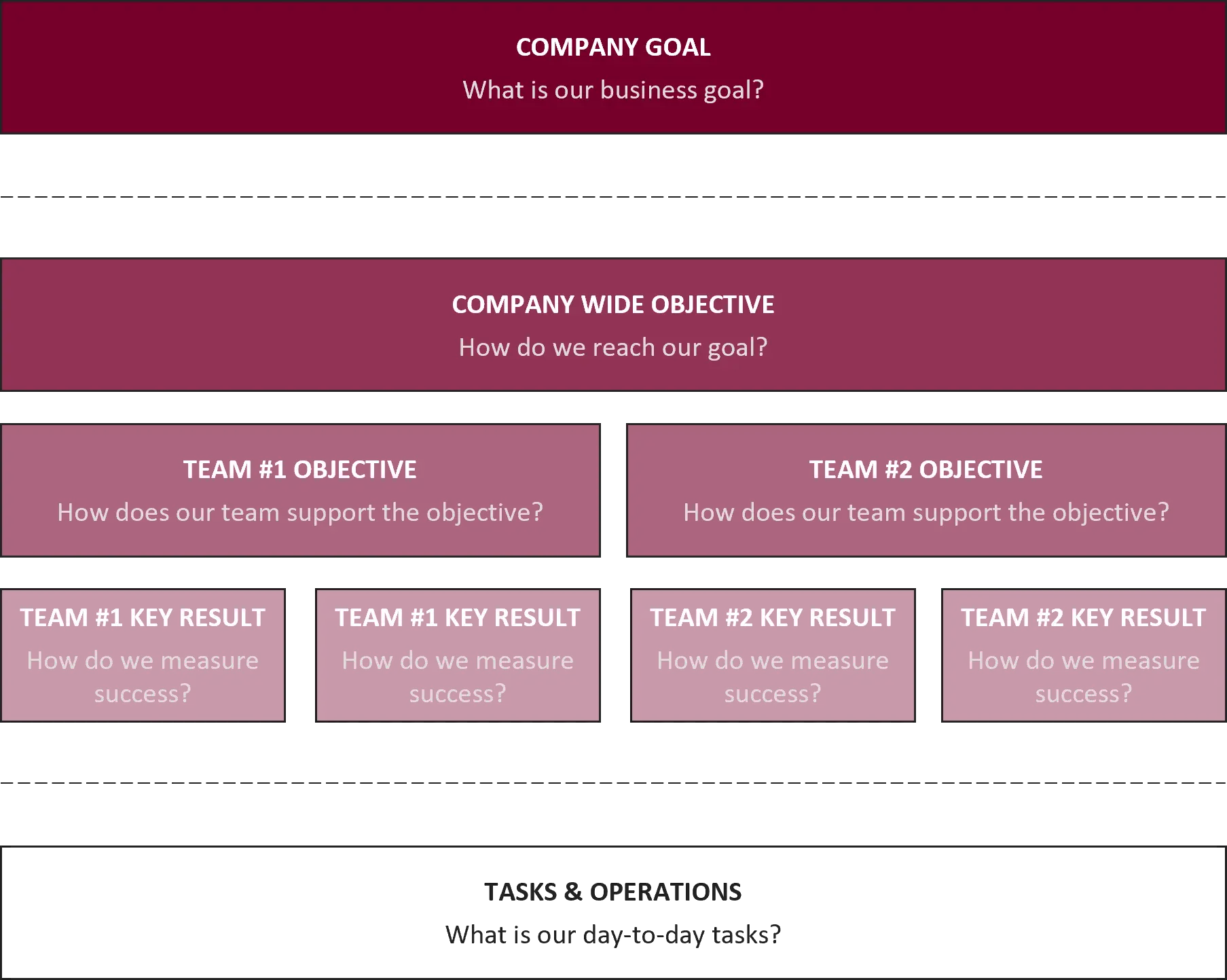
An OKR framework could, for example, look like this:
Make the marketing team’s contribution visible
OKR helps translate overarching business goals into clear, measurable sub-goals. This allows us to continuously track whether we are moving in the right direction.
OKR is also an excellent tool for visualising priorities and connections. It becomes clear to everyone what is prioritized, when - and by who. This creates alignment across teams and departments.
The CMO and the marketing team can use OKR to clearly demonstrate how their work contributes to the company’s strategic goals - and thereby reclaim their important role as a driver of business growth.
With an OKR framework, the strategy becomes visible, concrete, and understandable for the entire organisation, as each department is given its own initiatives and goals.
How does it work in practice?
Let’s say, for example, that your overall business goal is to grow revenue by 20%. But where should that growth come from? By using OKR, you break the growth target down into concrete focus areas and initiatives across individual teams.
A shared focus for all teams could be omnichannel. For retail, that might mean opening more stores and ensuring that in-store staff save receipts online.
For the ecommerce team, it might involve creating a seamless integration between the POS system and the commerce platform. Meanwhile, marketing could focus on activating the data collected in stores through segmented campaigns. In this way, the focus area is clear to everyone, while the specific initiatives and responsibilities remain team specific.
The goal is to create an operational engine where objectives and KPIs run across the entire business. When each team succeeds, the business succeeds. Facilitating this alignment is a role your CMO is well positioned to own.
3 concrete steps you can take
- Let your CMO help define the business strategy - not just execute the strategy others have
- Implementan OKR framework to create structure, clarity, and concrete actions and
milestones tied to the - Helpboth the marketing team and the rest of the organisation make it clear how each
team contributes to achieving the company’s